

During the autumn of 2015, discussions were held about how to work together and in the best way to pursue infrastructure issues that affect the region. Instead of various stakeholders having to pursue the issues separately, Ludvika municipality, Smedjebacken municipality, Hitachi Energy (then ABB) and Ovako agreed that Samarkand2015 should be a unifying force and a forum.
Some areas for improvement
To develop and improve rail traffic on the routes Ludvika-Västerås-Stockholm and Örebro-Gävle respectively. To improve opportunities for road transport, including on national roads 50 and 66 and develop alternative routes for heavier goods. To work for a functioning common housing market in Ludvika-Smedjebacken. There must be a mixed attractive offer that meets population development in the long term and contributes to regional attractiveness
Bergslagpendeln's interest group
The Bergslagspendeln has an important function to connect the Ludvika – Västerås – Stockholm route. Affected municipalities, regions and the larger companies in the area have therefore formed Bergslagpendeln’s interest group, BIG.
The aim is to influence the relevant authorities to develop the measures and efforts needed in the short, medium and long term to develop the railway route all the way to Stockholm. The importance of the Bergslag pendulum for regional development is shown, among other things, by the fact that in order to develop it, SEK 120 million has been set aside in Västmanland’s county plan to extend the meeting track in Brattheden to Ramnäs. The municipalities concerned in Västmanland and Dalarna have also allocated SEK 20 million for the purpose. The municipalities have access to the station areas, and efforts have been made to increase functionality and attraction there. This is exemplified below.
Extended regional traffic produces positive societal effects
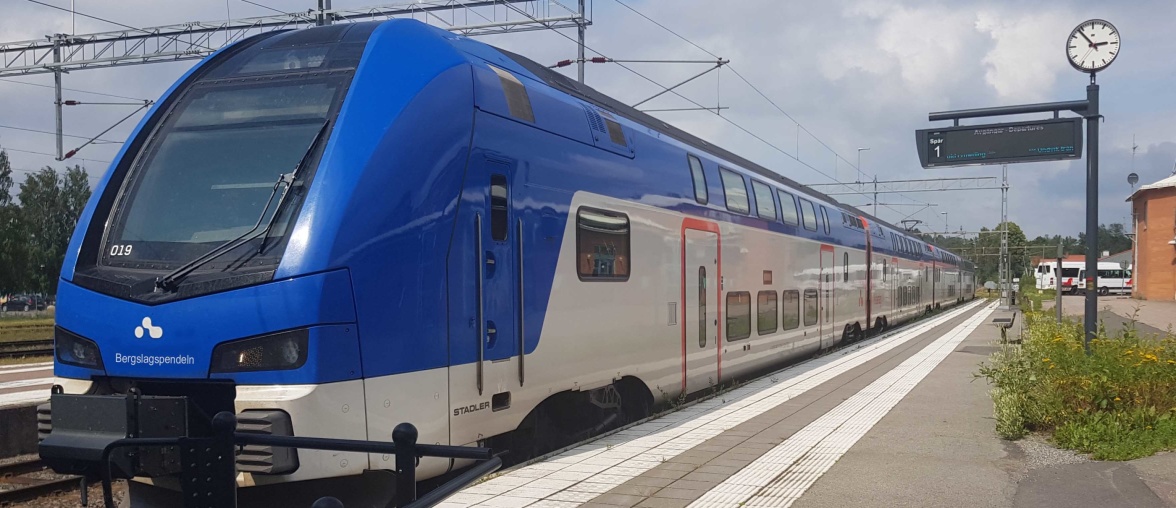
Extended regional traffic on the Bergslagspendeln with system meetings in Fagersta creates the conditions for positive development along the route. It is therefore important that future investments in public transport and infrastructure are coordinated with local efforts. Joint work must be carried out with a focus on local development. The municipal efforts have so far, among other things, led to improved parking facilities for cars and bicycles at the stations, improved infrastructure for bus operations, i.a. at Smedjebacken’s jvstn. Good accessibility to public transport reduces car dependence. Thus, the Bergslag pendulum contributes to reduced emissions and gives more access a wider range of jobs and leisure activities. The route is also strengthened by creating conditions for the development of a more diversified business life.
Work commuting contributes to better community development
Commuting has been shown in many studies to increase material prosperity among people. Those who commute often have higher education and are therefore dependent on being able to reach a larger labor market. A common reason for commuting is that employment in another location leads to a higher salary. At the same time, increased commuting leads to companies finding it easier to find labor with in-demand skills. Thus, increased commuting contributes to business life being able to develop more easily. Access to a geographically larger market with a larger population base also favors specialization, which in itself contributes to increased growth. Through such a development, tax power also increases. However, the tendency to commute decreases with increasing travel time. Already after 20 minutes of travel time, it begins to decrease sharply. At ride times over one hour, it decreases drastically. Therefore, it is important to be able to minimize the travel time. In the socio-economic calculation models that the Swedish Transport Administration uses for its priorities between different investment objects, the dynamic effects in the form of e.g. Increased employment and rising wage sums that increased commuting usually leads to. The opportunities to use the ride time to work, sit comfortably, have the opportunity to have coffee, etc. Increases the propensity to commute longer distances. Experience from other parts of the country shows that trains are usually perceived to offer higher travel time quality than buses.
Larger labor market regions provide increased growth
There are currently three local labor markets along the Bergslagspendeln. The largest, Västerås, includes i.a. The municipalities of Västerås, Hallstahammar and Surahammar. The municipalities of Fagersta, Norberg and Skinnskatteberg form their own local labor market. Ludvika forms a local labor market together with Smedjebacken and Ljusnarsberg. There is a connection between the size of the labor market and economic growth. Small labor market regions usually decrease in both population and employment. Achieving larger labor market regions is therefore a way to increase growth. At the same time, the growing industry in the area has a great need to be able to recruit highly educated labor that is currently not available in the area. One such recruitment is Hitachi’s need to hire 600 new people in the near future, most of them in Ludvika.
Traffic-wide approach
In order to contribute to the creation of larger labor market regions, an over-traffic approach is required where trains are a part. Train systems and infrastructure must be built up so that they allow cost-effective and attractive traffic with departures on fixed minutes. The connecting bus traffic must also be attractive and cost-effective and allow for smooth changes to and from track-borne traffic. To limit costs, the number of vehicles needed for the desired supply must be minimized. Trains in Bergslagen’s, TIB’s, owners have decided to invest in new vehicles for a cost of approx. SEK 120 million/trainset. The annual leasing cost per train set amounts to the order of SEK 7.8 million. In addition to this, there are costs for drivers and other on-board personnel. Together, this means an annual operating cost increase of more than SEK 10 million. If another train vehicle must be put into service at an unchanged tour supply. This must be taken into account when traffic arrangements and consequent measures in the track are discussed. Different ways to set up traffic mean that more or fewer vehicles are required. At the same time, the needs of the market must be taken into account. Many school hours have been changed in the route to provide the opportunity for cost-effective public transport that also provides new opportunities for long-distance work commuting. Not least the alarm reports on ongoing climate change show that it is necessary to increase public transport’s current low market share in the area. Today’s large car dependence also reduces the possibilities for matching between job seekers and employers.
Today's public transport travel
Since Västmanland’s local traffic took over responsibility for the Bergslag pendulum between Fagersta and Västerås in 1989, travel increased from 100,000 in the same year to 621,000 in 1995. Until 2010, train travel decreased to just under 540,000. The bus travel had at the same time increased to 183,000 trips in the route. The reason for the reduced train travel is in all probability the strong expansion of bus traffic to Västerås. In 2019, just under 350,000 train journeys were made on the entire Bergslagspendeln. In the same year, approx. 615,000 bus trips were made in Ramnäs – Surahammar – Västerås. North of Fagersta there is no bus service that can be considered an alternative to train travel. Collective travel has thus increased sharply on the part of Fagersta – Västerås. Between Fagersta and Ludvika, the range is too sparse to be attractive to the customer groups that have access to other travel options. The consequence of this is that Hitachi has been forced to arrange its own bus service Västerås – Ludvika. One reason for the reduced train travel is also that the rigid timetable that existed for many years has been dismantled. Stiff timetable with departures on fixed minutes usually increases travel in this type of traffic by 5 – 15 percent.
Desirable traffic arrangement
An arrangement with train meetings in Fagersta makes the town a hub. A fast-paced timetable is the basis for creating attractive train traffic for travelers. The point of timetable timetable is to place the meetings in important nodes, i.e. important junctions, where connections to other traffic, with symmetry as a basis, can be optimal. Then Fagersta, where the trains meet around the minute number 30, can connecting bus traffic that reaches minutes of 25 minutes and departs in minutes of 35. This gives a hub with exchange options in all travel relationships. The surrounding municipalities of Norberg and Skinnskatteberg as well as urban traffic in Fagersta then get the maximum benefit from a densified train service where Stockholm can be reached without a change in Västerås. In order to achieve the desired better integration between the local labor markets in Ludvika, Fagersta and Västerås, train traffic in the route must therefore be developed because trains provide shorter ride times than buses. The experience from the construction of the Svealandsbanan shows that there are great potentials for transferring travelers from car and bus to train and also creating new travel and positive population development. Since the line nowhere allows freight trains to run faster than 70 km/h, such a setup creates the opportunity to pre-plan fixed freight train locations that can easily be called off when demand arises.