

The rapid development in digitization and artificial intelligence places new demands on both energy systems and community planning. This was at the center when the Energy for Data Halls conference brought together representatives of authorities, energy companies, research, business and municipalities for a full day in Falun on April 27. Just over 100 people participated on site in Falu Gruva’s conference room and the same number participated via link.
The conference was started by Helena Höij, governor of Dalarna County, who emphasized the importance of knowledge, dialogue and long-term cooperation when new energy-intensive activities are established. She highlighted data centers as a strategically important issue for both regional development and Sweden’s competitiveness in the green and digital transition.
Today’s moderators Marit Ragnarsson, the County Administrative Board, and Linda Varga, High Voltage Valley, then handed over the floor to Tor Björn Minde, Rise, who gave an overall picture of data centers as a socially critical infrastructure. He described how AI development drives a rapidly increasing need for computing power, which in turn affects electricity use, power needs and cooling systems. A central message was that almost all the energy supplied in data centers is converted into heat – a challenge, but also an opportunity. With the right technology, waste heat can be recycled and integrated into local energy systems, where Sweden and Dalarna have particularly good conditions.
The conference deepened the perspective through concrete examples and system issues. Stefan Nilsson, Chief Commercial Officer at Conapto, described how modern data centers can function as “the friendly neighbor” in the energy system through high energy efficiency, renewable electricity, heat recovery and participation in balance reserves.
The establishment and development perspective was highlighted by Carl Romlin from EcoDataCenter, which showed how AI-driven growth creates an accelerating need for data center capacity. He emphasized that localization must be seen as an ecosystem where electricity, water, infrastructure, land and competence work together. Romlin also highlighted the potential of data centers’ heating and cooling systems and the conditions required for waste heat to be used.
From the perspective of the energy companies, David Berg, operations and project manager, described the electricity grid at Falu Energi & Water, how planning for large power outputs is carried out in practice – from voltage levels and network reinforcements to cooperation between local networks and regional networks.
Johan Hedman, CEO of Falu Energi & Vatten, and Mats-Erik Olofsson, CEO of Borlänge Energi, broadened the picture by lifting the whole in building robust and sustainable energy systems in interaction with large electricity users.
Google’s establishment
The international perspective was presented by Christopher Eckerberg, responsible for data center development in the Nordics at Google, who shared experiences from Google’s establishment in Avesta and described the global demands placed on operational reliability, energy solutions and climate performance
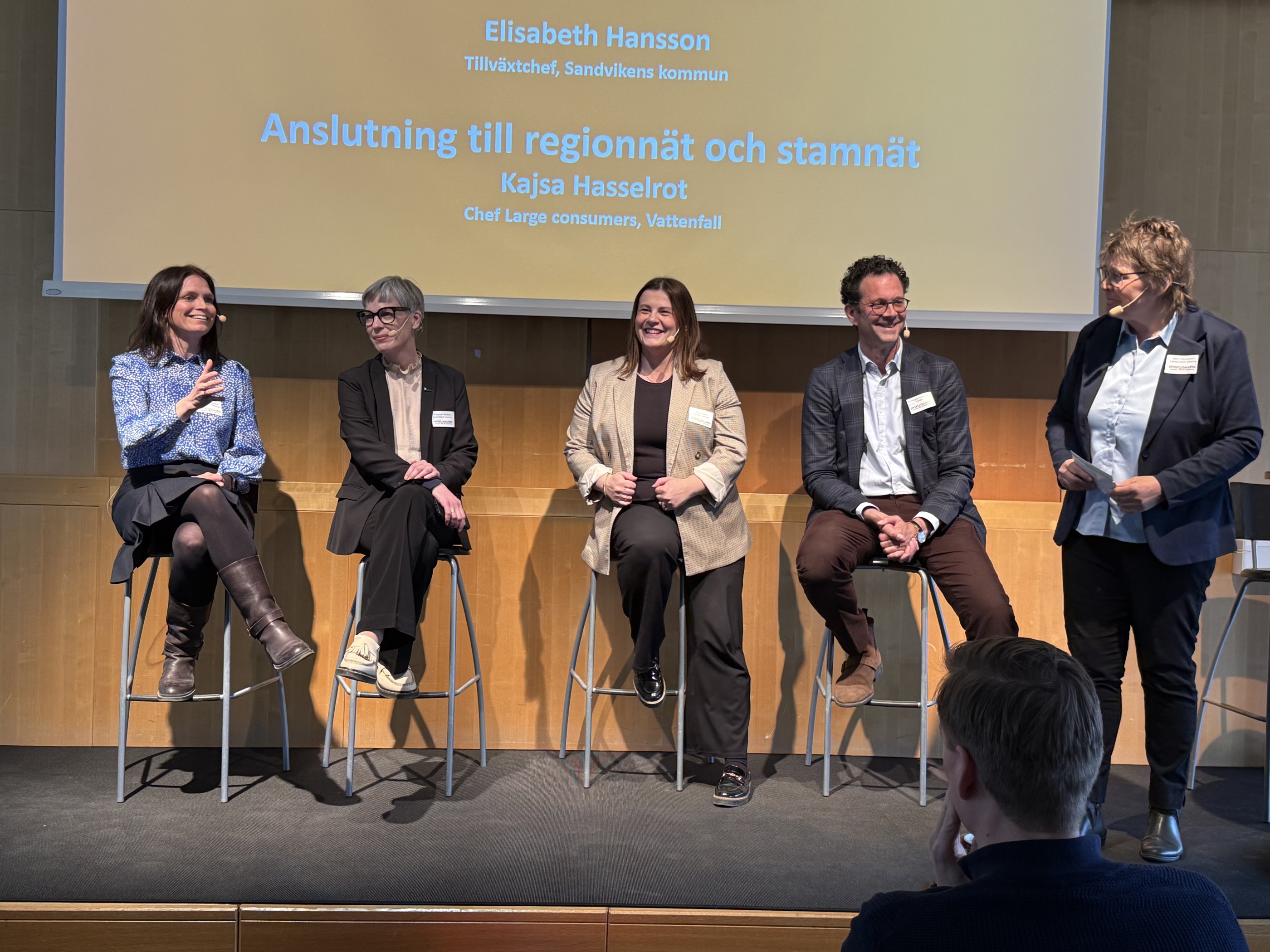
The importance of municipal planning was highlighted by Blerta Krenzi, chairman of the municipal board in Avesta municipality, and Elisabeth Hansson, head of growth in Sandviken municipality. They described how political consensus, clear processes and local dialogue are crucial to creating sustainable establishments with local acceptance. Questions about connecting to regional networks and main grids were raised by Kajsa Hasselrot, head of Large Consumers at Vattenfall, who described how large electricity users affect network planning and long-term capacity decisions.
Future focus was given through Angelica Ekholm from Dalarna Science Park, which presented the work to build a sustainable AI hub in Dalarna where energy, infrastructure, research and business are connected in a regional innovation ecosystem.
The sustainability and regulatory perspective was summarized by Isabelle Kemlin from RISE, who highlighted what is required for long-term sustainable data centers – from energy efficiency, liquid cooling and water management to the EU’s energy efficiency directive and demands for continuous improvement. In conclusion, Rebecca Roupe from Svenska Kraftnät connected today’s discussions by highlighting how sustainable data center establishments require long-term planning, coordination and system perspectives in order for the electricity system to develop stably.
An overall picture of the future
Overall, the conference showed that data centers are both a necessary prerequisite for digitization and AI – and a growing challenge for energy systems and community planning. The speakers’ common message was clear: the solutions exist, but they require a holistic view, early dialogue and cooperation between public actors, energy companies, business and research. Properly managed, data centers can become an engine for regional development, local energy benefit and Sweden’s continued green and digital transition.
Documentation
You can find all presentations and the recording of the day at energiintelligent.se. Scroll down a bit on this page.